

How much do custom patches cost?
- 日期:2026-03-09
- 分類:批發產品
How much do custom patches cost?
When people search for custom patches, one of the first questions they ask is: “How much do custom patches cost?” The challenge is that there is no single universal price. Custom patch pricing depends on multiple variables, including patch size, quantity, backing type, border style, embroidery coverage, colors, material choice, and production method. That is why two patch quotes can look very different even when both are described simply as “custom patches.”
For first-time buyers, the most important thing to understand is that patch pricing is not only about the patch itself. A proper quote may include setup work, digitizing or artwork conversion, sample approval, production, packaging, and shipping. In some cases, one supplier gives a low per-piece number but leaves out important details, while another supplier includes more services upfront. If you compare only the headline price, it becomes easy to misjudge which option is actually better.
Custom patches are commonly ordered for uniforms, clubs, military-style apparel, motorcycle groups, schools, promotional events, corporate branding, streetwear, outdoor gear, and merch lines. Each use case affects the type of patch needed. A patch for a fashion brand may focus on texture and detail, while a patch for workwear may focus more on durability and wash resistance. Because the end use changes the specification, it also changes the price.
That is why the best way to understand custom patch cost is not to ask for one “cheap price,” but to understand what drives the quote. Once you know the cost structure, you can request a more accurate estimate, compare suppliers properly, and choose a patch solution that fits your budget and purpose.
Why do custom patch quotes vary so much?
The biggest reason is that “custom patch” is a broad category. Embroidered patches, woven patches, chenille patches, PVC patches, leather patches, and printed patches all have different production methods and cost structures. Even within the same category, pricing changes based on size, stitch density, number of colors, special finishes, and attachment method. A simple logo patch with merrow border and iron-on backing is very different from a large tactical patch with Velcro backing and intricate detail.
Another key factor is quantity. Small runs usually cost more per piece because setup costs are spread over fewer units. Larger runs typically lower the unit price, although the total order value becomes higher. This is why asking “How much is one patch?” often does not reflect real manufacturing logic. Most suppliers price patches based on batch production rather than single-piece craftsmanship, unless it is a highly specialized handmade order.
Custom patch pricing breakdown
| Item | Description | What causes price differences |
|---|---|---|
| Patch type | Embroidered, woven, chenille, PVC, leather, or printed patch | Different materials and production methods have different costs |
| Size | Overall patch dimensions | Larger patches require more material and longer production time |
| Artwork setup | Digitizing or converting artwork for manufacturing | Complex logos or low-quality files may require extra prep work |
| Detail level | Fine lines, lettering, color transitions, texture detail | More intricate designs usually take more production time |
| Backing | Iron-on, sew-on, adhesive, Velcro, safety pin, magnetic | Some backing options cost more and suit different use cases |
| Border style | Merrow border, heat cut, laser cut, satin stitch | Custom shapes and premium edge finishes may cost more |
| Quantity | Total number of patches ordered | Larger orders often reduce the per-piece cost |
| Packaging | Bulk packing, individual poly bags, retail cards, branded packaging | Retail-ready presentation adds material and labor costs |
| Shipping | Delivery and logistics costs | Rush production, destination, and shipping speed affect total cost |
This table shows why a patch quote should always be read as a package of specifications, not just a single number. If one supplier includes artwork setup, sample revision, Velcro backing, and fast shipping, while another supplier only quotes the patch body itself, the difference in price is not necessarily unfair. It simply reflects a different scope.
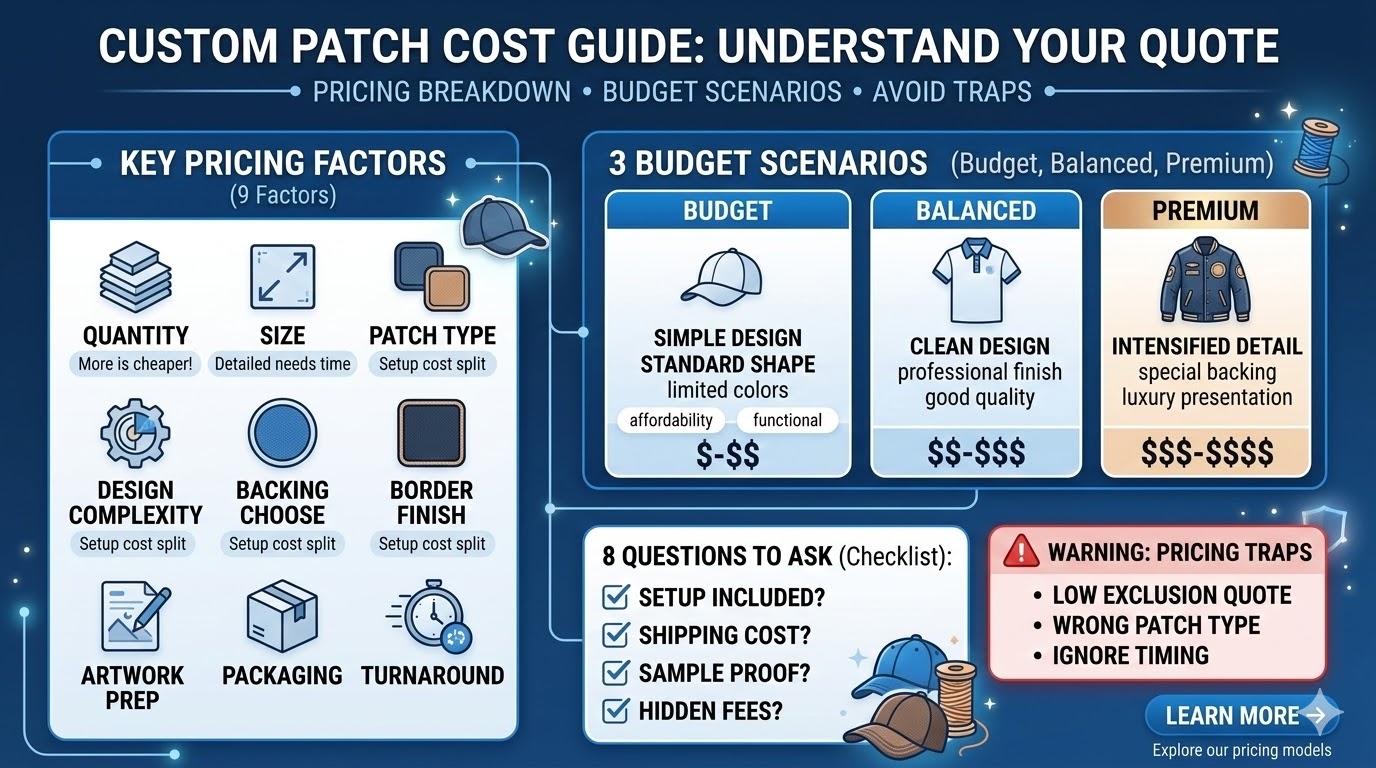
9 factors that affect custom patch pricing
- Patch type: embroidered, woven, chenille, PVC, leather, or printed
- Patch size and shape complexity
- Design detail, text size, and stitch density
- Backing choice such as iron-on, Velcro, or sew-on
- Border finish including merrow, laser cut, or satin edge
- Order quantity and whether it is a small run or bulk order
- Artwork preparation, digitizing, and sample revision needs
- Packaging requirements for retail, gifting, or internal distribution
- Turnaround time and whether the order is rush production
Among these factors, quantity is often the biggest driver of unit price, while design complexity is often the biggest driver of production difficulty. If your design includes tiny text, thin outlines, gradients, or highly detailed icons, the supplier may recommend a different patch style than you originally planned. For example, woven patches often work better than embroidered patches when you need smaller lettering and sharper detail.
How your use case affects the quote
A patch for a police-style uniform, a fashion hoodie, a baseball jacket, and a retail souvenir may all look like patches, but they do not require the same specifications. Uniform patches may need strong stitching and wash durability. Fashion patches may prioritize visual texture and premium branding. Event giveaway patches may need lower unit cost and faster production. Tactical or outdoor patches often request hook-and-loop backing and durable materials. The more clearly you explain your intended use, the more realistic the quote will be.
3 budget scenarios: budget, balanced, premium
Budget option: keep it simple and functional
If your main goal is affordability, the best route is usually a simple design, limited colors, standard shape, basic backing, and a quantity that makes production efficient. This works well for schools, clubs, team identification, giveaways, or internal use. A budget-focused patch can still look good, but it should avoid overly intricate elements that force unnecessary production complexity.
For buyers in this category, the most practical strategy is to prioritize what really matters: readability, durability, and a clean finish. Simplifying the design often saves more money than trying to negotiate an unrealistically low price after the design is already locked.
Balanced option: good quality with smart cost control
This is the most common choice for brands, corporate merch, motorcycle clubs, sports teams, and organizations that care about both appearance and cost efficiency. A balanced custom patch order usually includes a more polished design, durable backing, and enough refinement to feel professional without moving into highly specialized premium features.
In this range, buyers often choose better materials, cleaner border finishes, and slightly more detailed artwork. The goal is not to build the most expensive patch possible, but to make sure the finished product reflects the brand or organization properly.
Premium option: detail, branding, and presentation
Premium patch orders are common in fashion labels, collector drops, high-end merch, and specialized branded applications. These projects may involve custom materials, luxury packaging, precise finishing, layered textures, unusual shapes, or special attachments. In these cases, the patch is not just an accessory. It becomes part of the product identity.
If you are using custom patches as a resale product or a key branding element, higher investment may make sense. The important point is not to pay more for the sake of paying more, but to spend where it improves quality, brand perception, and end-user experience.
8 questions to ask before approving a quote
- What exactly is included in the quote: setup, sample, production, packaging, and shipping?
- What patch type do you recommend for my design, and why?
- What file format do you need, and is artwork cleanup included?
- What backing and border options are included in this price?
- Is there a minimum order quantity, and how does pricing change at higher quantities?
- Can I review a digital proof or production sample before full production?
- What is the turnaround time, and will rush production cost extra?
- Are there any additional fees for revisions, special packaging, or split shipping?
These questions help prevent the most common misunderstandings. A good supplier should be able to explain not just the total price, but the logic behind it. If a quote feels vague, or the supplier avoids discussing production details, that is usually a warning sign.
Common pricing traps and red flags
A low quote that excludes critical items
One of the most common issues in custom patch buying is receiving a very attractive quote that does not include setup work, proofing, specialty backing, or shipping. The price looks good at first, but after those items are added, the final total becomes much higher. That is why you should never compare quotes without checking the scope line by line.
Using the wrong patch type for the design
Some buyers focus only on cost and choose embroidered patches even when the artwork is too detailed for embroidery to reproduce clearly. This can lead to disappointment, redesign costs, or a finished product that does not match expectations. A more suitable production method may cost slightly more but produce a much better result.
Ignoring turnaround and approval timing
If you need patches for an event, uniform rollout, or product launch, timing matters as much as price. Some suppliers quote only production time and do not clearly include proof approval, revision rounds, or shipping transit. This can create delays even when the quoted lead time seemed acceptable.
No clear quality standard
If there is no sample, no proof approval, and no written confirmation of size, backing, color, and finish, it becomes harder to resolve disputes later. Quality problems are not always caused by bad production. Sometimes they come from unclear specifications. The safer approach is to document everything before production begins.
Custom patches FAQ
How much do custom patches usually cost?
Custom patch pricing varies based on size, quantity, patch type, backing, design complexity, and production method. The best way to get an accurate estimate is to provide your artwork, desired size, quantity, and intended use.
Are there hidden fees in custom patch quotes?
There can be, especially if the quote does not clearly state whether artwork setup, sample approval, special backing, packaging, or shipping are included. Always ask for a full breakdown before placing the order.
How long does custom patch production take?
Production time depends on the supplier, order size, patch type, and whether revisions are needed. Rush service may be available, but it often increases the total cost.
What payment structure is common for custom patch orders?
Many suppliers require payment upfront or a deposit before production begins, especially for custom-made items. Terms vary, so it is important to confirm payment milestones before approving the order.
What is the cheapest type of custom patch?
The most affordable option often depends on the design and quantity. Simple embroidered or printed patches can be cost-effective for basic artwork, but the best low-cost choice depends on your exact specification.
Which patch type is best for small text and fine detail?
Woven patches are often a better choice than embroidered patches when the design includes fine text or detailed lines, because they can reproduce smaller details more cleanly.
Does ordering more patches lower the price?
In most cases, yes. Larger orders usually lower the unit price because setup and production costs are spread across more pieces, although the total order amount will still increase.
Is Velcro backing more expensive?
Velcro backing often costs more than standard sew-on or iron-on options because it adds extra material and assembly work. It is popular for tactical gear, uniforms, and removable patch use.
Can I order custom patches without finished artwork?
Yes, but artwork preparation may affect the quote. Some suppliers can help clean up a logo or convert a rough idea into production-ready artwork, and that service may be included or billed separately.
How do I get a custom patch quote?
To get a useful quote, send your design or logo, preferred patch size, estimated quantity, backing type, border preference, deadline, and any packaging needs. The more complete the information, the more accurate the quote will be.
In the end, custom patch pricing is not about finding one fixed number. It is about understanding the variables behind the quote and making sure the specification matches your actual purpose. For first-time buyers, that means comparing quotes carefully, asking the right questions, and avoiding the mistake of choosing only by the lowest visible price. A well-scoped quote saves time, reduces rework, and gives you a patch that actually performs the way you need it to.