

Patch Factory: Start with These 3 Key Checks
- 日期:2026-03-09
- 分類:工業工程
Patch Factory: Start with These 3 Key Checks
A patch factory specializes in the production of functional patches used in cosmetics, skincare, medical care, and wellness products. These patches may include hydrogel patches, transdermal patches, acne patches, or eye masks designed for targeted delivery or localized treatment.
Before selecting a patch factory for product development or manufacturing, it is important to review several essential factors to ensure quality and production efficiency.
- Check manufacturing capability: Ensure the factory has the equipment and expertise for patch production.
- Verify material sourcing: Raw materials such as hydrogel or adhesive layers should meet safety standards.
- Confirm quality control systems: A reliable patch factory should implement strict testing and quality management.
Understanding these basics can help businesses select the right manufacturing partner and develop products more efficiently.
Common Types of Patch Factory Products
Patch factories typically produce a wide variety of products across different industries, particularly skincare and wellness.
| Patch Type | Material Base | Common Applications |
|---|---|---|
| Hydrogel patches | Hydrogel polymer | Eye masks, wrinkle care |
| Acne patches | Hydrocolloid | Blemish protection |
| Transdermal patches | Adhesive drug matrix | Active ingredient delivery |
| Cooling patches | Gel sheet | Cooling and soothing |
| Functional cosmetic patches | Hydrogel or bio-cellulose | Targeted skincare treatment |
Patch Manufacturing Process and Evaluation Steps
Step 1: Product concept development
The process begins with defining the product concept, including target function, ingredients, and patch type.
Step 2: Formula and material selection
Manufacturers select suitable materials such as hydrogel bases, adhesives, and active ingredients.
Step 3: Prototype development
A prototype is created to evaluate texture, adhesion, ingredient compatibility, and performance.
Step 4: Stability and safety testing
Testing ensures that the patch maintains quality, stability, and safety under different conditions.
Step 5: Mass production
Once approved, the product moves into large-scale production with automated equipment.
Step 6: Packaging and quality inspection
Final products undergo quality inspection before packaging and distribution.
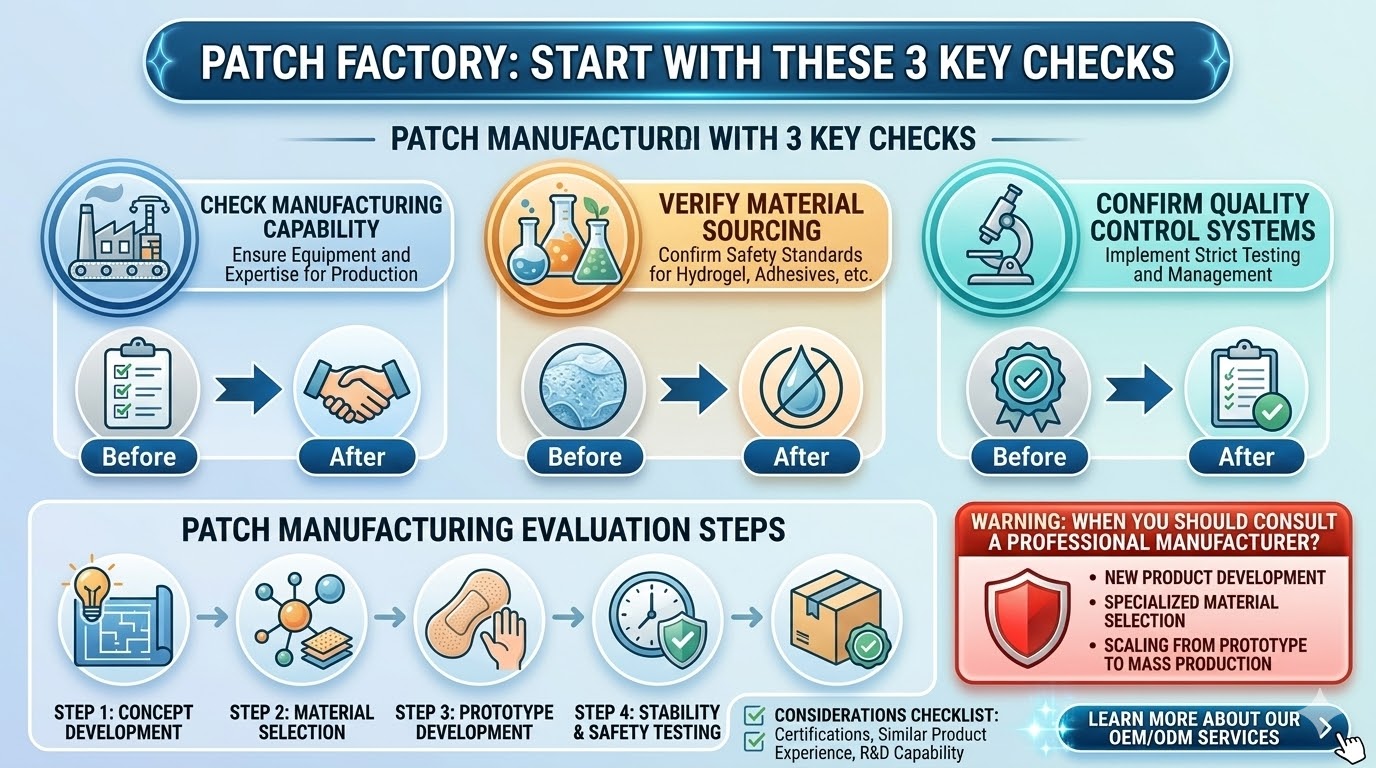
When You Should Consult a Professional Manufacturer
In some cases, working directly with an experienced patch factory or product development team is essential.
- When developing a new patch-based product
- When selecting specialized materials or ingredients
- When scaling production from prototype to mass manufacturing
- When navigating regulatory requirements
- When ensuring product stability and safety
Professional consultation can help ensure that the final product meets both technical and market requirements.
Important Considerations When Working with a Patch Factory
- Confirm the factory’s certifications and production standards
- Evaluate experience in similar patch products
- Review research and development capabilities
- Ensure clear communication during product development
- Verify packaging and logistics capabilities
A reliable manufacturing partner can significantly improve product quality and time-to-market.
FAQ
What is a patch factory?
A patch factory manufactures functional patches such as hydrogel patches, acne patches, and cosmetic patches.
What products can a patch factory produce?
Common products include skincare patches, hydrogel masks, acne patches, and transdermal patches.
How long does patch product development take?
Development time varies depending on formulation, testing, and production requirements.
Can patch factories offer OEM or ODM services?
Many manufacturers provide OEM and ODM services for brand owners.
What materials are commonly used in patches?
Common materials include hydrogel, hydrocolloid, bio-cellulose, and adhesive matrices.
Are patch products regulated?
Regulations depend on product type and local regulatory requirements.
Can patch products deliver active ingredients?
Some patches are designed to deliver ingredients through localized or transdermal systems.
How do manufacturers ensure patch quality?
Quality is maintained through raw material testing, stability studies, and production control.
What industries use patch manufacturing?
Patch technology is used in cosmetics, skincare, wellness, and healthcare products.
How do brands choose the right patch factory?
Brands usually evaluate experience, certifications, production capacity, and R&D capability.